This article looks at the Gordon Dump Cemetery close to Albert on the Somme. I have also written a series of guides to help you research those who served in the British Army during the war:
Gordon Dump Cemetery
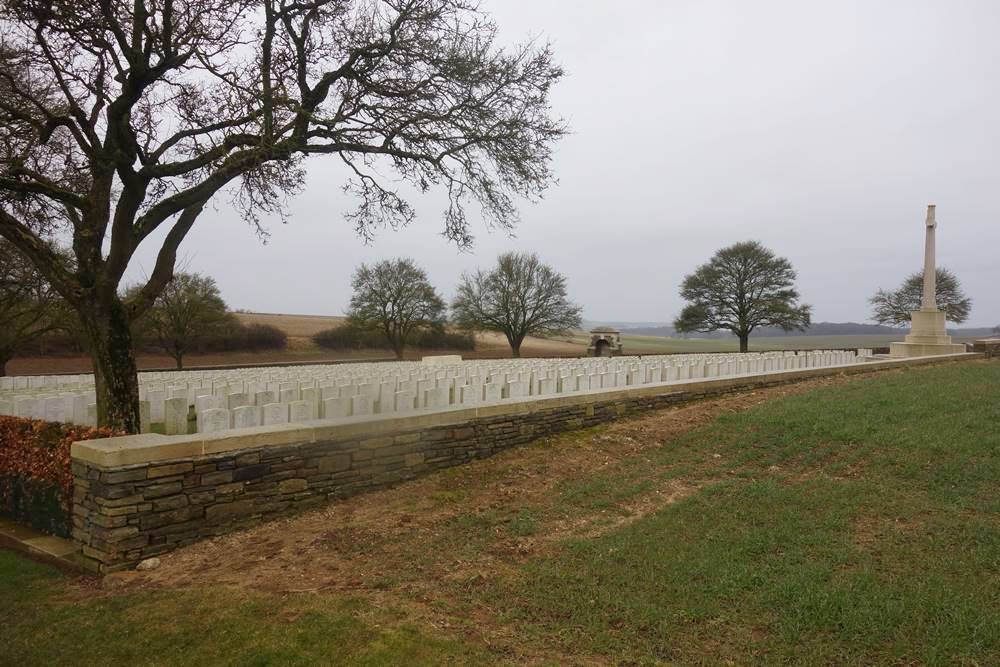
The Gordon Dump Cemetery is a First World War cemetery for British and Commonwealth soldiers who lost their lives on the Somme. The cemetery is located between the villages of La Boisselle and Contalmaison, just over three miles to the northeast of Albert. If you visit, you’ll access the cemetery down a grass-covered path from the D20. The cemetery is signposted and easy to find as it sits in the middle of a farmer’s field and you can park at the top of the path. The cemetery contains the graves of 1,676 Commonwealth soldiers who died fighting in the area of whom only 624 are identified. Gordon Dump Cemetery was created in July 1916, shortly after the Battle of the Somme began on 1 July with the first burials continuing until September. Then, after the Armistice, Gordon Dump Cemetery was chosen to concentrate burials in the surrounding area. Of the identified burials, over three hundred lost their lives on 1 July. The earliest identified casualty buried in the cemetery is Rifleman James Ernest Ward of the 13th Battalion King’s Royal Rifle Corps who was killed in action on 10 June 1916. Gunner Ernest John Foot of B Battery 122nd Brigade Royal Field Artillery who was killed in action on 27 August 1918 is the last.
The extract below is from Sheet 57d SE with trenches corrected to 15 August 1916. The blue line shows the British front line on 1 July with the red lines German trenches. Gordon Dump Cemetery is marked by a black dot with each side of a small square 500 yards (457 meters). The cemetery was built in Sausage Valley with Mash Valley on the other side of La Boisselle. Part of Mametz Wood is shown to the east of Contalmaison. 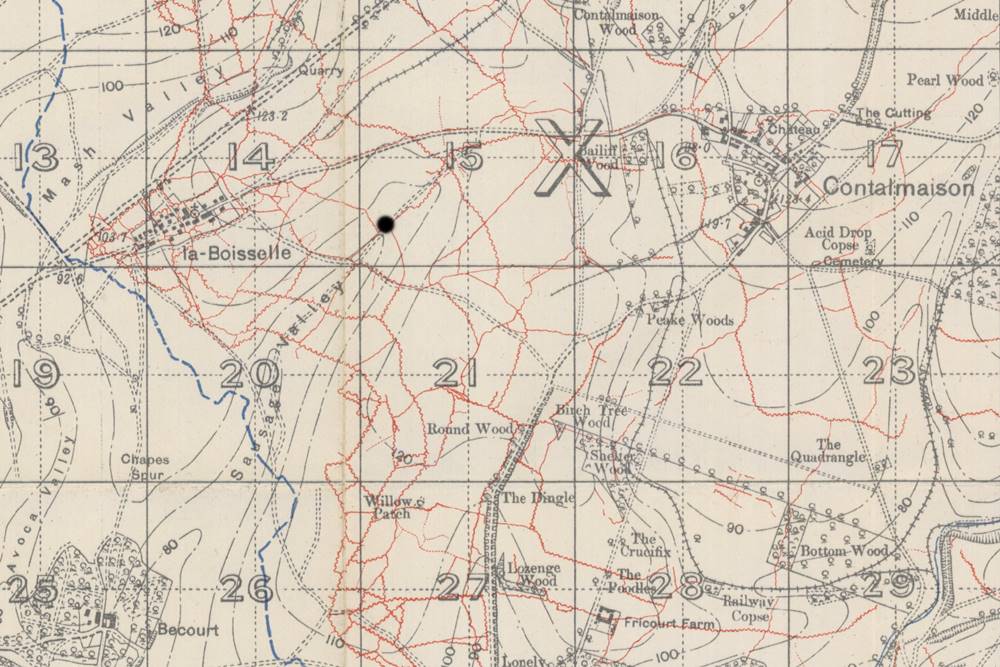 One of the men buried in the cemetery is Second Lieutenant Donald Simpson Bell who was awarded the Victoria Cross while serving with the 9th Battalion Alexandra, Princess of Wales’s Own (Yorkshire Regiment). On 5 July 1916, during an attack on Horseshoe Trench which was to the south of the cemetery. His citation was published in the London Gazette on 9 September 1916:
For most conspicuous bravery. During an attack a very heavy enfilade fire was opened on the attacking company by a hostile machine gun. Second Lieutenant Bell immediately, and on his own initiative, crept up a communication trench and then, followed by Corporal Colwill and Private Batey, rushed across the open under very heavy fire and attacked the machine gun, shooting the firer with his revolver, and destroying gun and personnel with bombs. This very brave act saved many lives and ensured the success of the attack. Five days later this very gallant officer lost his life performing a very similar act of bravery.
The men buried either side of Bell had been awarded military medals for gallantry but their citation cards were destroyed in the Blitz. Private Myer Freedman, was killed in action serving with the 10th Battalion Duke of Wellington’s (West Riding Regiment) on 19 September 1916. Freedman’s epitaph “To Live In Hearts We Leave Behind Is Not To Die” is one you’ll see frequently on headstones.

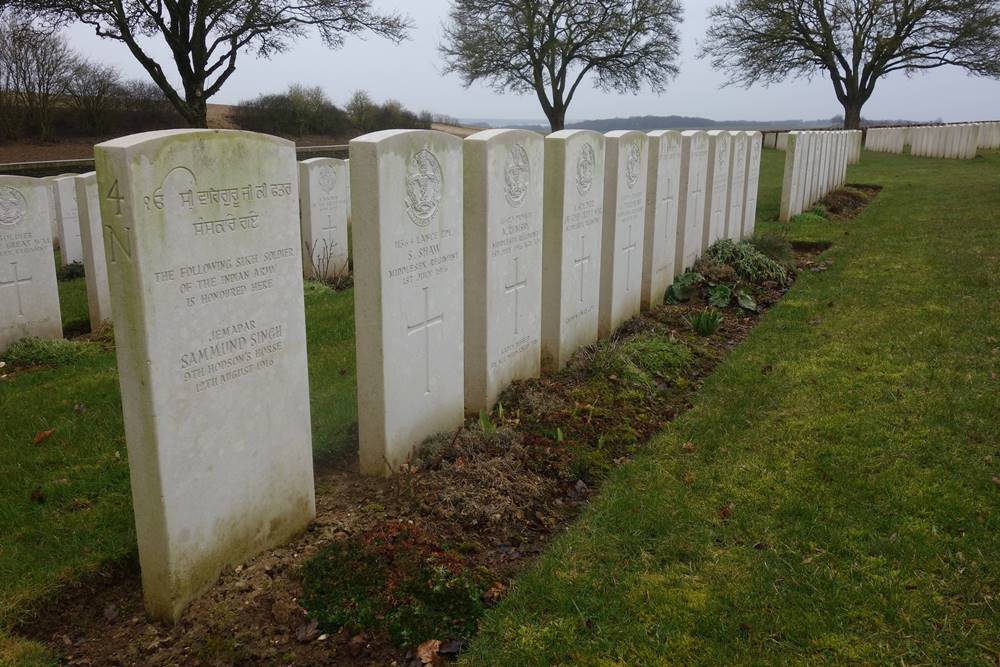
Only a single Indian soldier is known to be buried in Gordon Dump Cemetery, Jemadar Sammund Singh of the 9th Hodson’s Horse. Where possible, most Sikh dead were cremated in accordance with their religious custom. Therefore, you don’t tend to find that many graves of Sikhs considering the numbers who died during the war. The Regiment contained Sikhs, Dogras, Punjabi Muslims and Pathans. The destruction of Indian service and medal records has meant that Indian soldiers are often impossible to research. However, Sammund Singh’s rank was Jemadar which meant that he was a Viceroy’s Commissioned Officer and therefore appears in the Indian Army List. Unfortunately, he doesn’t appear in the January 1916 Indian Army List so he was promoted to Jemadar shortly before his death. He was probably in his mid to later thirties at the time of his death.
The Regiment’s war diary recorded on 12 August 1916 “Jemadar Samund Singh killed Second Lieutenant P. V. Douetil wounded while working with party attached III Corps between Contalmaison and Mametz Wood”. Singh was killed somewhere in the vicinity of Acid Drop Copse Cemetery which is marked on the above map and a short walk from where he was subsequently buried. On 12 August, the 9th Hodson’s Horse was at Querrieu fifteen miles southwest of Gordon Dump Cemetery. The war diary reported that Singh’s working party, initially containing eighty men but increased to two hundred was “Bivouacked near Becourt Chateau and working on dugouts and trenches in area Contalmaison – Mametz Wood”.