This article looks at the Lancashire Landing Cemetery at Gallipoli and at some of those buried there. I have also written a number of other articles on cemeteries and landmarks of the campaign and guides to help you research soldiers who served in the British Army:
Lancashire Landing Cemetery
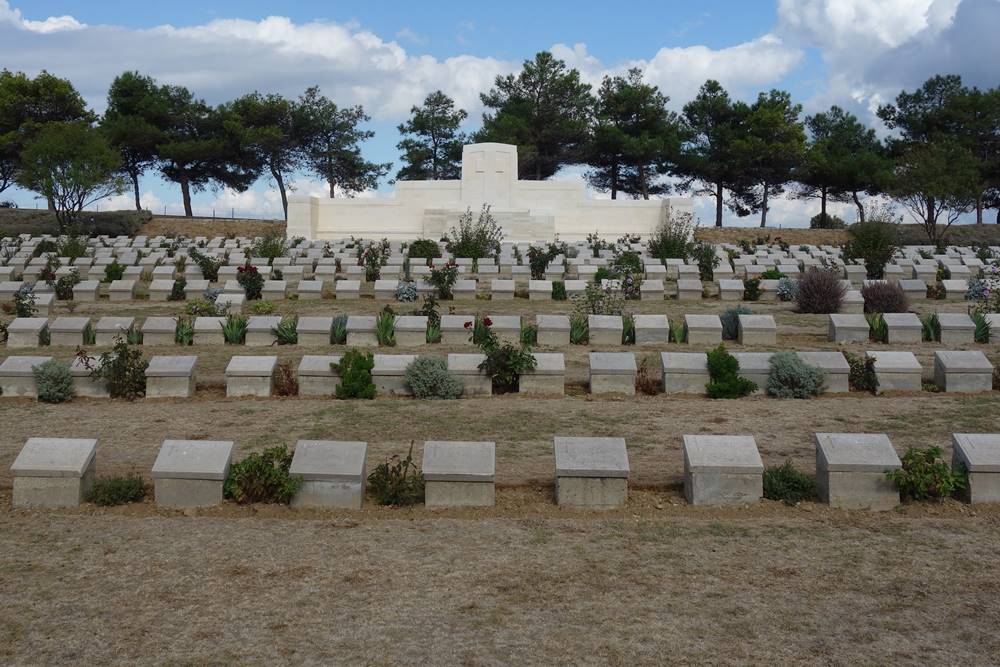 The Lancashire Landing Cemetery contains the graves of 1,237 Commonwealth service personnel who died during the Gallipoli campaign with 1,114 of the graves being identified. This is a higher percentage of identified burials than is usually found for a cemetery in Gallipoli. Lancashire Landing Cemetery was in use throughout the campaign. After the Armistice, the cemetery was used to concentrate graves from the Kephalos British Cemetery, Kusu Bay Cemetery and Panaghia Churchyard on Imbros and the Paraskevi Cemetery on Tenedos (Bozcaada). The cemetery takes its name from the 1st Battalion The Lancashire Fusiliers who landed nearby at W Beach on 25 April 1915. The Battalion suffered heavy casualties as they landed, climbed the cliffs and pushed on inland. Six Victoria Crosses, the highest gallantry award of the British Army, were awarded to men of the Battalion. This attack became known as the ”six VCs before breakfast”. There are only six identified burials for soldiers killed on 25 April 1915, all to officers. Four of the officers, Captains Thomas Bowyer-Lane Maunsell and Aubrey Jocelyn Thomas, Lieutenant Alwyne Porter and Second Lieutenant Ellis Clark were serving with the 1st Battalion Lancashire Fusiliers. The view below is looking from the cemetery towards Cape Helles and V Beach, with the Helles Memorial to the right.
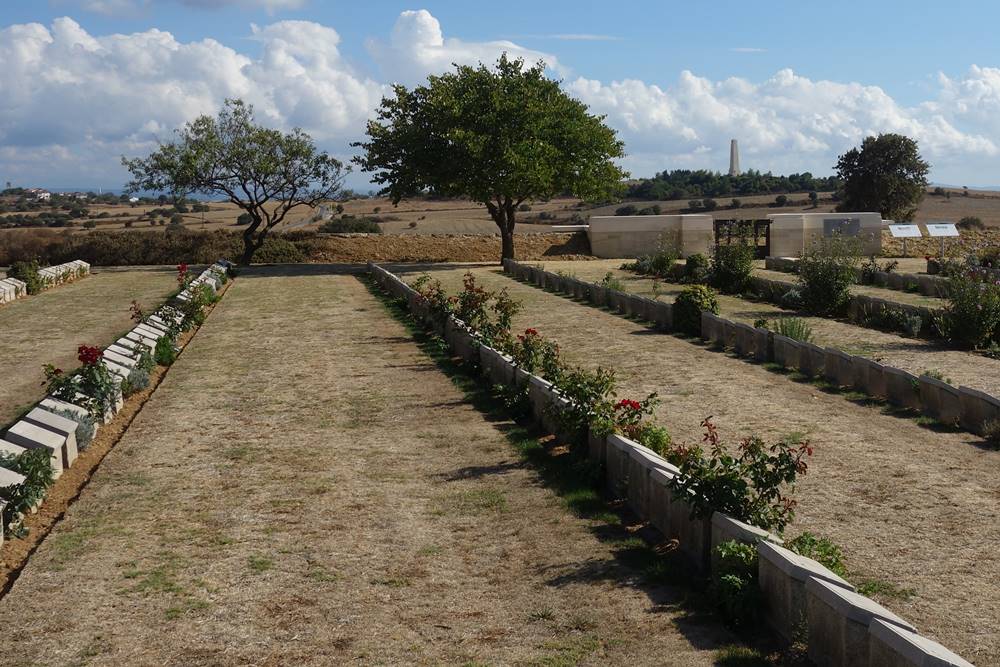 The map below shows the location of Lancashire Landing with the cemetery inland. A road runs from Sedd el Bahr (Seddulbahir) to the cemetery which is about a mile away from the Helles Memorial. You can’t miss the cemetery and a track leads down to W Beach. If you continue further down the road, heading away from the Helles Memorial, you will come across a track on your left leading down to Gully Ravine. It is well worth a detour. Continue up the road and you’ll pass the Pink Farm Cemetery before you reach Krithia (Alçıtepe). The distance between Lancashire Landing Cemetery and Alçıtepe is 4.4 miles (7.1km).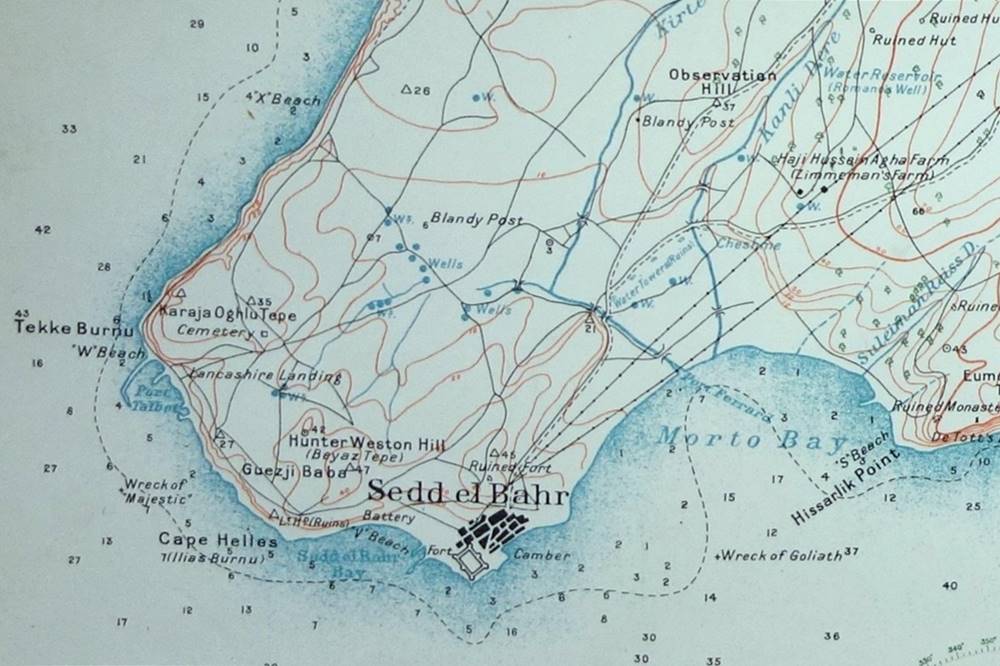
One of the men awarded the Victoria Cross on 25 April 1915 with the 1st Battalion Lancashire Fusiliers, Private William Kenealy, is buried in the cemetery. Kenealy survived the landing but was mortally wounded at the Battle of Gully Ravine on 28 June 1915 and died the next day. Kenealy’s Victoria Cross was one of three initially awarded by ballot, and the following citation was published in the London Gazette, 24 August 1915:
On 25th April, 1915, three Companies, and the Headquarters of the 1st Battalion Lancashire Fusiliers, in effecting a landing on the Gallipoli Peninsula to the West of Cape Helles, were met by a very deadly fire from hidden machine guns which caused a great number of casualties. The survivors, however, rushed up to and cut the wire entanglements, notwithstanding the terrific fire from the enemy, and after overcoming supreme difficulties, the cliffs were gained and the position maintained. Amongst the many very gallant officers and men engaged in this most hazardous undertaking, Captain Willis, Serjeant Richards, and Private Kenealy have been selected by their comrades as having performed the most signal acts of bravery and devotion to duty.
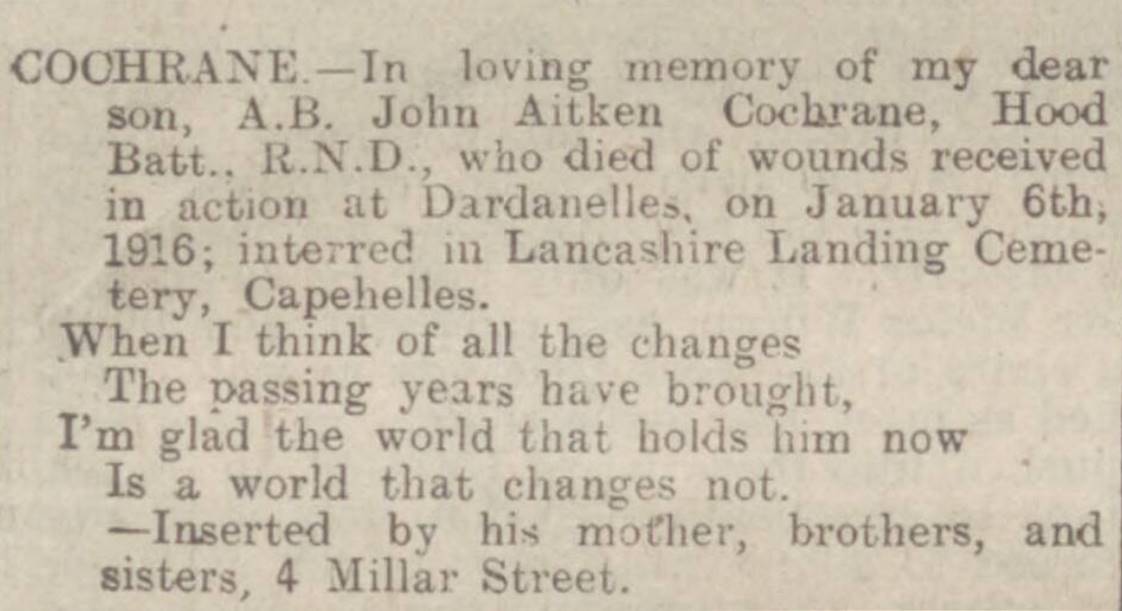
One of the last men to be buried in the cemetery, prior to the Allied evacuation was Able Seaman John Aitken Cochrane who died of wounds in the 11th Casualty Clearing Station aged eighteen on 6 January 1916. Cochrane was serving with the Hood Battalion of the Royal Naval Division and was reported as suffering from multiple gunshot wounds, a term used for both bullets and shrapnel. He had only been posted to the Hood Battalion in late October 1915 and had spent time in a field ambulance in December being treated for a septic foot. An in memoriam notice was published in The Motherwell Times on 7 January 1921 from his family.